


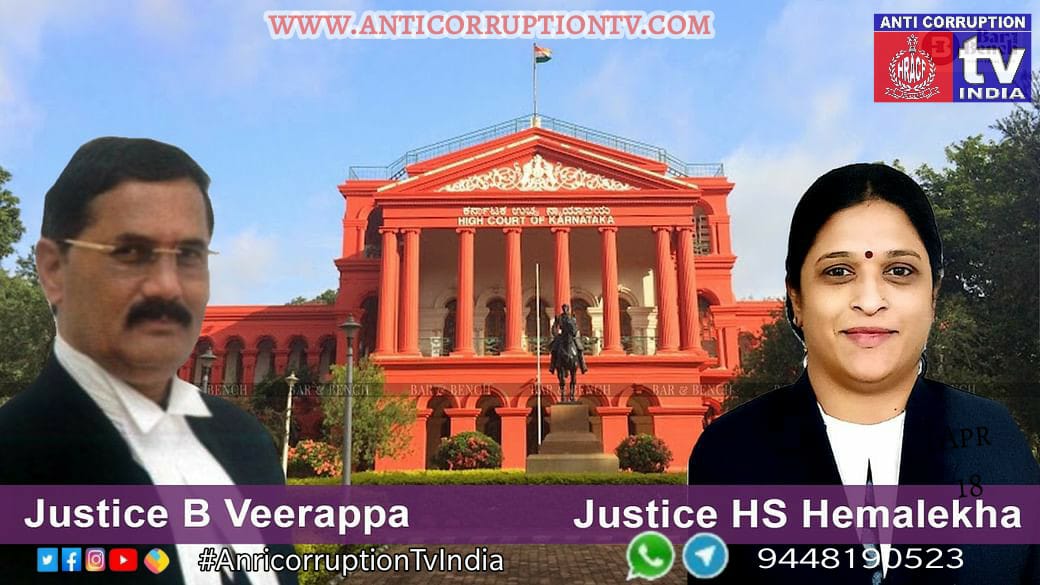

Karnataka : “It is unfortunate that even after 75 years of independence, no political party has the will to allow or support an independent body like Lokayukta to work transparently in the public interest,” the Karnataka High Court expressed regret.
A division bench headed by Justices B Veerappa and KS Hemalekha , which dismissed the impugned orders of the state government regarding formation of the ACB, made several important points in its historic 289-page judgment delivered on Thursday.
- If the objective of the state government is to prevent corruption, bias and indiscipline of officers in administration, ACB should have been allowed to work under the Lokayukta under section 15(3) of the Karnataka Lokayukta Act instead of the Chief Minister as mentioned in the state government order.
- There is a high scope for political interference in the government mandate and ACB can be misused by the incumbent Chief Minister to control opponents within the party or in the opposition. The order clarifies the possibility of favoring the authority or the party in authority.
- As ACB and Intelligence Advisory Board are under the direct administrative control of the State Government, they cannot work independently. These ultimately come under the control of the Chief Minister.
- The government did not consult the Lokayuktas while withdrawing the statutory notifications dated February 6, 1991, May 8, 2002 and December 5, 2002, which empowered the Lokayukta police to conduct investigations under the Control of Corruption Act and declared the offices of Inspectors of Police of the Karnataka Lokayukta as police stations under Section 2(S) of the CrPC. Statutory notifications cannot be withdrawn by order of the Government without consultation with the Lokayukta.
- Obviously, the state government has not given any reason for forming ACB as an alternative to Lokayukta. Based on the recommendation of the State Director General of Police and the Supreme Court’s judgment in C Rangaswamayya’s case, the ACB on March 14, 2016 issued the formation order and defined the duties of officers of the Karnataka Police Force. Here the Supreme Court judgment is misunderstood. C Rangaswamayya case judgment was announced on July 21, 1998 and on March 14, 2016, the government ordered the formation of ACB for the first time. That is, after 18 years, the ACB was formed, and in the impugned order, the Supreme Court judgment was wrongly mentioned.
- Statutory rules cannot be deleted unless ordinances can fill the vacuum that the rule does not cover. The government order indirectly curtailed the powers of the Lokayukta. ACB cannot work as an alternative or separate body to Lokayukta. Thus, there is no legal validity to the ACB formation order to perform the work given to the Lokayukta.
- Since the formation of ACB, no criminal case has been filed against any Minister, MP, MLA, Legislative Council member. A case has been filed against some authorities and raids have been carried out. Neither the government nor ACB has submitted any document to prove that ACB is more effective than Lokayukta. ACB was created to protect vested interests and not to protect public interest on a broader basis.
- Lokayukta and sub-lokayukta posts have been turned into toothless paper tigers by the creation of ACB. In this regard the posts of Lokayukta and Upalokayukta need to be strengthened and their directives should not be confined to paper.
- It is an important time for legislative and judiciary to eradicate corruption, corruption is more deadly than cancer to the next generation. This has hindered the development of the country especially the development of Karnataka.
- When the Karnataka Lokayukta Act is in existence, the state government cannot remove the officers given to the Lokayukta body under the Act by creating the ACB as per the mandate of Article 162 of the Constitution.
- Governments that have ruled over time have not taken strict measures to eliminate corruption. The Karnataka Lokayukta came into effect on 15th January 1998 and worked independently until the government ordered.
- The manner in which the Karnataka Lokayukta and its police force investigated the mining scam has created a lot of trust in the institution among the common people. Here the ACB was created to protect the political elite and the bureaucracy thereby indirectly defeating the purpose of the Lokayukta Act.
- A complainant cannot be an investigator as per CrPC sections. If a case is registered against the Chief Minister or a member of the Council of Ministers as per the objectionable order of the Government, the Chief Minister himself should supervise the investigation and allow the investigation. Thus, the impugned order is contrary to law and the order of the Supreme Court.
- The ACB cannot have independent police officers when the Karnataka Police Act 1963 is already in place. A police officer working under the Home Department cannot be expected to impartially investigate higher officials as an ACB investigator.
- In 2011, the Lokayukta made history in the state by using the powers under the Karnataka Lokayukta Act to force the resignation of the Chief Minister and Ministers and also sent them to jail, which became a model for the country. Lokayukta’s son was about to resign after allegations of corruption came against him. The bench reminded that all this is possible and it is important because of the Lokayukta and Control of Corruption Acts.


